Hire an n8n Expert: A Guide to Automation Strategy, AI Agents, and Complex Builds
Looking to hire an n8n expert for a bigger automation project? Here's how expert-level engagements differ from a simple build, what to expect, and how to choose well.
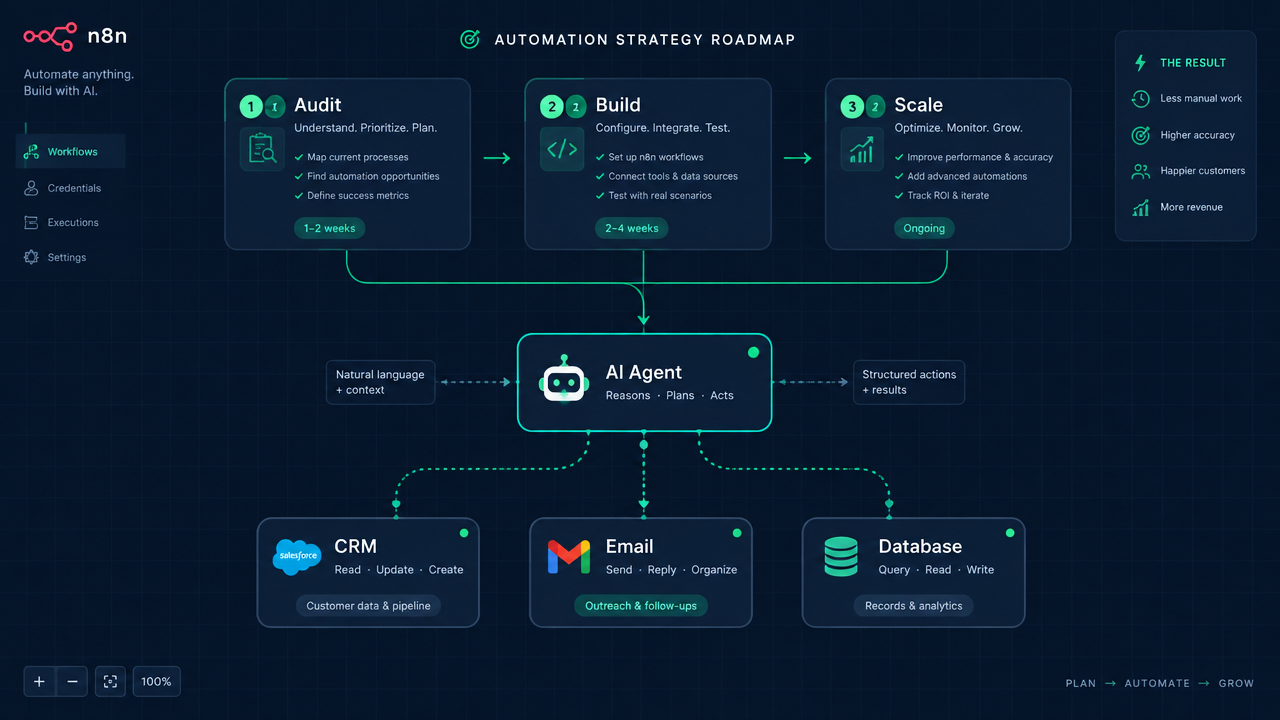
Ready to bring in an n8n expert?
Browse Vetted n8n Experts and ConsultantsThere's a moment in a lot of companies' automation journey where the questions stop being "can someone build this workflow" and start being "what should we even be automating, and in what order." That's usually the point where people start searching for an n8n expert rather than just an n8n developer. The distinction matters more than it sounds like it should.
A developer builds what you tell them to build. An expert helps you figure out what's worth building in the first place — which processes actually save meaningful time, which ones are too brittle to automate yet, and how to sequence a handful of workflows so they don't step on each other six months from now. If you're past your first simple integration and looking at something bigger — a multi-department rollout, a customer-facing AI agent, or a system that needs to hold up under real production load — this guide is for you.
If instead you already know exactly what you want built and just need someone to build it, our guide to hiring an n8n developer covers that more directly. This page is for the messier, bigger version of the problem.
What "Expert" Actually Means in an n8n Hiring Context
The word gets used loosely, so it's worth being specific about what separates expert-level engagements from a standard project.
Depth across the whole n8n surface area, not just a handful of familiar nodes. An expert has usually worked with self-hosted deployments, n8n's queue mode for handling high volume, custom node development, and the AI/LangChain nodes — not just the popular integrations everyone uses.
Judgment about what not to automate. Anyone can string nodes together. An expert can tell you when a process is too inconsistent to automate reliably yet, or when the right fix is cleaning up the underlying data first, not building a workflow around messy data.
Comfort operating at scale. Handling thousands of daily executions, managing concurrency limits, and designing workflows that degrade gracefully instead of falling over when volume spikes.
Strategic sequencing. Knowing which automation to build first so it doesn't conflict with the next one — a real issue once you have more than two or three workflows touching the same systems.
Communication with non-technical stakeholders. A lot of expert-level work involves explaining tradeoffs to people who don't know what a webhook is, and getting buy-in across a team, not just delivering code.
None of this means you need to pay agency rates for a single-app integration. It means that once your project has real complexity or real stakes, the skill you're hiring for shifts from "can build" to "knows what to build and why."
Signs You Need an Expert, Not Just a Developer
A few situations tend to call specifically for expert-level help rather than a standard project-based build:
- You're automating across four or more departments and need someone who can map dependencies between workflows
- You're building an AI agent that makes decisions or takes actions (not just summarizing or drafting), where a mistake has real consequences
- You're migrating from Zapier or Make and need someone to redesign the logic for n8n's execution model, not just recreate it node-for-node
- You need a self-hosted, high-availability setup with proper monitoring, not a single cloud workflow
- Your team has tried building automations internally and hit a wall around reliability, not just the initial build
- You need someone who can also train your internal team, not just hand off a finished product
- Compliance, data residency, or security review is part of the project, not an afterthought
If migration is what's driving the search, it's worth reading how n8n compares to Zapier and Make first — the execution-model differences are exactly what an expert redesigns, and knowing them upfront makes the engagement cheaper.
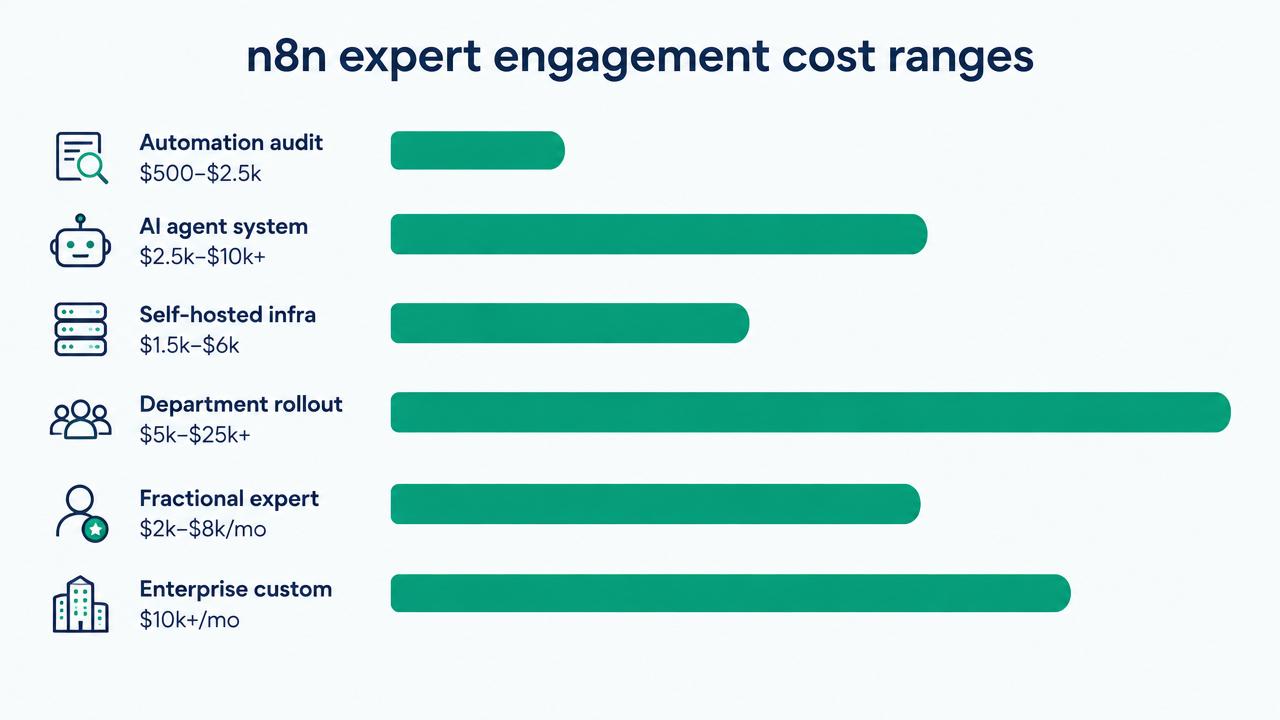
What Hiring an n8n Expert Costs
| Engagement type | Typical range | What you're actually paying for |
|---|---|---|
| Automation audit / strategy session | $500–$2,500 flat | A prioritized roadmap of what to automate and in what order |
| Complex AI agent system (multi-step reasoning, tool use) | $2,500–$10,000+ | Design, guardrails, testing, and iteration on model behavior |
| Self-hosted infrastructure setup (HA, monitoring, security) | $1,500–$6,000 | Deployment architecture, not just workflow logic |
| Multi-workflow department rollout | $5,000–$25,000+ | Sequencing, documentation, training, and handoff |
| Fractional n8n expert (ongoing, part-time) | $2,000–$8,000/month | Continuous strategy, builds, and maintenance as needs evolve |
| Enterprise engagement (dedicated team) | Custom, often $10,000+/month | SLAs, security review, dedicated support |
As with any project-based estimate, get a written scope before committing, and be wary of anyone quoting a number in the first conversation before understanding your systems. For reference on hosting itself, n8n's official pricing page covers the execution-based cloud tiers and the free, unlimited self-hosted Community Edition — that's a separate cost from whoever you hire to build on top of it.
What to Look for in an n8n Expert
| Signal | Why it matters |
|---|---|
| Can explain a past project where they recommended against automating something | Shows judgment, not just execution |
| Has deployed n8n in queue mode or handled high-execution-volume projects | Confirms they've worked past the "single simple workflow" stage |
| Has built and shipped an AI agent with guardrails (not just a demo) | Distinguishes real production experience from a proof of concept |
| Asks about your team's technical comfort level before proposing a solution | Signals they design for handoff, not just for themselves |
| Has documentation or training materials from past engagements | Shows they think about what happens after they leave |
| References from engagements similar in size to yours | A great freelancer for small projects isn't automatically right for a multi-team rollout |
A useful test during a first call: describe your messiest, most ambiguous process — the one you're not even sure is automatable — and see how they respond. A strong expert will ask clarifying questions and might tell you it's not ready to automate yet. Someone who immediately says "yes, easy, I can build that" without knowing the details is giving you a sales answer, not an expert one.
The official n8n community forum is also a useful vetting ground: watching how someone explains tradeoffs and debugs problems in public tells you more than any polished proposal does.
Hiring for AI Agent Work Specifically
A large share of "hire n8n expert" searches right now are really about AI agent projects — workflows where an LLM doesn't just draft text but makes decisions, calls tools, or takes actions inside other systems. This deserves its own section because it's where expert-level judgment matters most, and where a lot can quietly go wrong.
The difference shows up in the questions an expert asks before building. Where a developer might jump straight to prompt design, an expert wants to know what the agent is allowed to do without approval, what happens when the model is confidently wrong, and how every action gets logged so a human can audit it later. Guardrails — approval gates, scoped tool access, output validation, and a fallback path when the model fails — are what separate an agent you can trust in production from an impressive demo. If you're scoping this kind of project yourself first, our n8n AI agents guide covers the building blocks in detail.
This is also the clearest place the developer-versus-expert price gap earns itself back. A mis-scoped AI agent doesn't fail loudly; it drafts the wrong refund email, updates the wrong CRM record, or takes an action nobody signed off on — quietly, at scale, every day until someone notices.
Questions to Ask Before You Sign Anything
- 1
"What would you prioritize first if you were in my position, and why?" — Tests whether they're actually thinking strategically or just agreeing with whatever you propose.
- 2
"How do you handle a project where the scope turns out to be bigger than expected once you're inside the systems?" — A clear, calm answer here beats a vague one.
- 3
"Who on your team actually does the hands-on build, if it's not just you?" — Important if you're hiring what looks like a solo expert but expecting agency-level output.
- 4
"What does handoff look like at the end of the engagement?" — Documentation, training, and access transfer should be part of the plan, not an afterthought.
- 5
"Can you show me a workflow you're proud of that's still running today, a year later?" — Longevity is a better signal than a one-time demo.
A Short Word on Contracts for Larger Engagements
For expert-level work, a written agreement matters more than it does for a single small workflow, since the stakes and the scope for disagreement are both bigger.
At minimum, get clarity in writing on: what's in and out of scope, who owns the resulting workflows and any documentation, how data is handled (especially if customer or financial data is involved), what happens if the project timeline slips, and what ongoing support looks like after launch.
For anything involving compliance requirements — healthcare, finance, or other regulated data — confirm upfront that the expert has actually worked under those constraints before, not just that they're willing to.
Frequently Asked Questions
What's the real difference between hiring an n8n developer and an n8n expert?
A developer typically builds what you specify. An expert helps determine what's worth building, in what order, and how to design it so it holds up at scale.
Do I need an n8n expert for a small project?
Usually not. If you have one clear workflow in mind touching a couple of apps, a solid freelance developer is a better fit. Expert-level hiring makes more sense once complexity, scale, or strategy is part of the ask.
How do I know if an n8n expert actually has the experience they claim?
Ask for specifics: a project where they advised against automating something, a workflow still running a year later, or how they've handled a failure in production.
Can an n8n expert also help with tools outside of n8n itself?
Many can, since automation strategy often touches the broader stack, including CRMs and data warehouses. It's worth asking directly since some experts specialize narrowly in n8n itself.
Is it worth hiring an expert just for an automation audit, without committing to a full build yet?
Often yes. An audit or strategy engagement is a lower-risk way to get a prioritized roadmap before committing budget to a larger build.
How long does an expert-level engagement typically take?
An audit or strategy pass might take one to two weeks. A multi-workflow rollout or complex AI agent system can run anywhere from a month to several months.
Final Thoughts
The line between "hire a developer" and "hire an expert" isn't really about title inflation — it's about whether your problem is a defined build or an open-ended one. If you already know exactly what you want and just need it built well, you can save money going with a strong freelance developer. If you're staring at a messy process, a bigger rollout, or an AI-driven system where getting the guardrails wrong actually matters, that's when paying for judgment — not just execution — earns its cost back.
Ready to bring in an n8n expert for your next project?
Browse vetted consultants and automation specialists on n8nmarkets, reviewed specifically for the complexity of work they've actually shipped.
Browse Vetted n8n Experts