Hire an n8n Developer: How to Find, Vet, and Work With n8n Experts
A practical guide to hiring an n8n developer — what they cost, how to vet them, red flags to avoid, and where to find vetted n8n experts for your automation project.
Ready to hire an n8n developer?
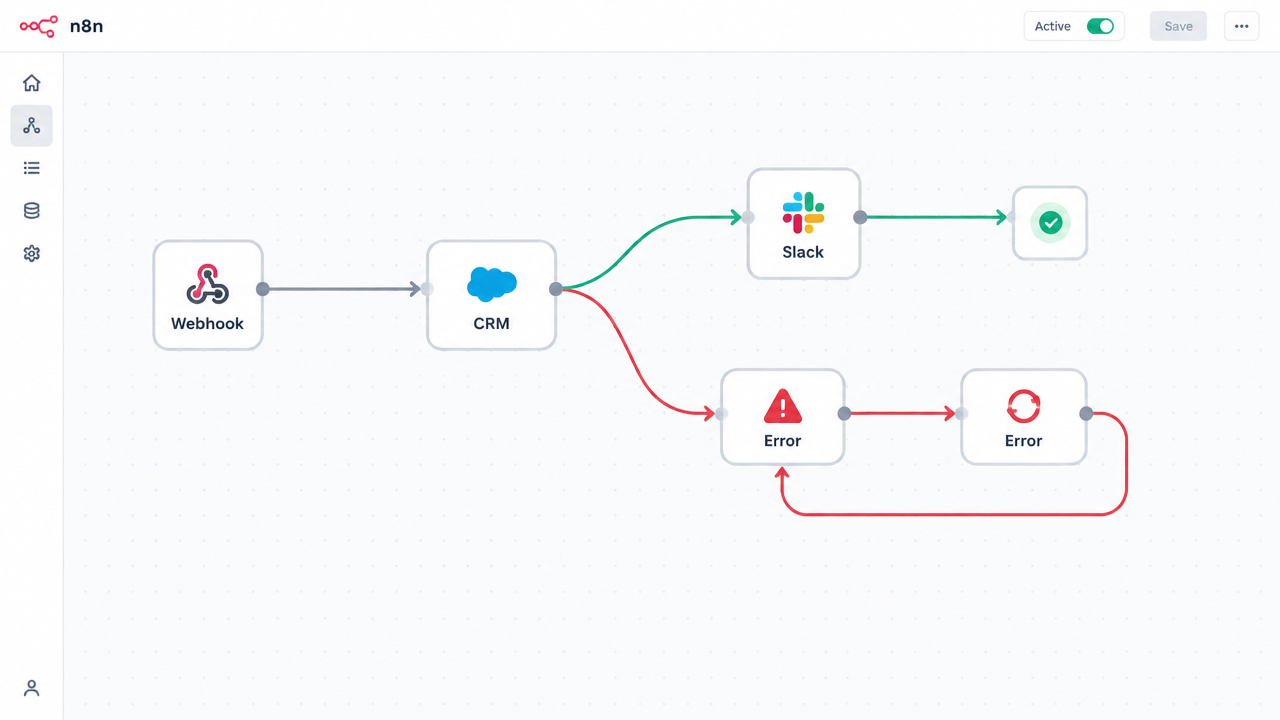
Browse Vetted n8n ExpertsIf you have spent an afternoon inside n8n trying to get a webhook to talk to a CRM and a Slack channel at the same time, you already know why people hire n8n developers instead of building everything themselves. The visual editor makes the basics look easy. The moment you add branching logic, retries, rate limits, or an AI agent node into the mix, things get complicated fast — and a workflow that looks fine in testing can quietly fail in production three weeks later.
This guide is written for founders, operations leads, and marketing teams who are past the "maybe we should automate this" stage and are now trying to figure out who should actually build it. We cover what n8n developers do day to day, what it costs to hire one, how to tell a strong candidate from a weak one, and where to find people who have actually shipped production workflows — not just watched a tutorial once. If you want a dedicated specialist instead, see our guide to working with an n8n expert.
What Does an n8n Developer Actually Do?
An n8n developer designs, builds, and maintains automated workflows inside n8n — the open-source, node-based automation platform. That sounds simple, but the day-to-day work usually splits into a few distinct categories.
Workflow design and architecture. Before anyone touches the canvas, a good developer maps out the trigger, the branching logic, and the failure points. This is the part that separates someone who has automated a handful of personal tasks from someone who has built systems that run unattended for months.
Integration work. Most projects involve connecting apps that were not designed to talk to each other — a CRM, a billing platform, a support inbox, an internal database. n8n ships with hundreds of pre-built nodes, but plenty of real-world projects need custom HTTP requests, authentication handling, or a bit of JavaScript inside a Code node to reshape data between steps.
Error handling and monitoring. This is the part beginners skip and experienced developers obsess over. What happens when an API times out? When a field is empty that should not be? A workflow with no error branches will eventually fail silently, and you will not find out until someone asks why a customer never got their invoice.
AI agent and LLM workflows. A growing share of hiring requests are for AI-specific builds — routing support tickets through a model, running automated research pipelines, or building a retrieval-augmented chatbot that pulls from your own documents.
Ongoing maintenance. APIs change. Rate limits shift. A node that worked fine in March breaks in July because a third-party service updated its schema. Developers who offer maintenance retainers are worth their fee here, because someone needs to notice before your customers do.
Hire n8n Developer vs. n8n Expert vs. n8n Consultant: Is There a Difference?
People use these terms almost interchangeably, but in practice they signal slightly different things when you are browsing profiles or job posts.
| Term | What it usually signals | Best for |
|---|---|---|
| n8n developer | Someone who builds and codes workflows, often comfortable with JavaScript, APIs, and self-hosting | Custom builds, integrations, ongoing dev work |
| n8n expert | A broader label — could be a developer, a no-code specialist, or a trainer | General project work, one-off builds |
| n8n consultant | Focuses on strategy: which processes to automate, tool selection, ROI analysis | Larger orgs planning automation across multiple teams |
| n8n freelancer | Independent contractor, typically project-based or hourly | Smaller, well-scoped projects |
| n8n agency | A team, usually with a project manager, handling larger or ongoing engagements | Complex builds, enterprise clients, SLAs |
None of these titles are regulated, so do not put too much weight on the label alone. A portfolio of real, working automations tells you far more than a job title does.
When You Actually Need to Hire Someone (And When You Don't)
Not every automation needs a developer. If you are connecting two apps with a single trigger and a single action — say, "new form submission adds a row to a spreadsheet" — you can probably build that yourself in an afternoon using n8n's own documentation.
Hiring starts to make sense once one or more of these is true:
- The workflow touches three or more systems with conditional logic between them
- You need error handling that actually alerts a human instead of failing quietly
- You are working with an API that has thin documentation or unusual authentication
- The automation is customer-facing, so a failure has a real cost
- You want it self-hosted, and someone needs to set up and secure that infrastructure
- You need an AI agent that reasons over your own data, not just a simple chatbot wrapper
- Your team's time is worth more spent elsewhere than in trial-and-error debugging
If none of those apply, save the budget and build it yourself first. You can always bring in a developer later to harden or extend what you started.
What Hiring an n8n Developer Actually Costs
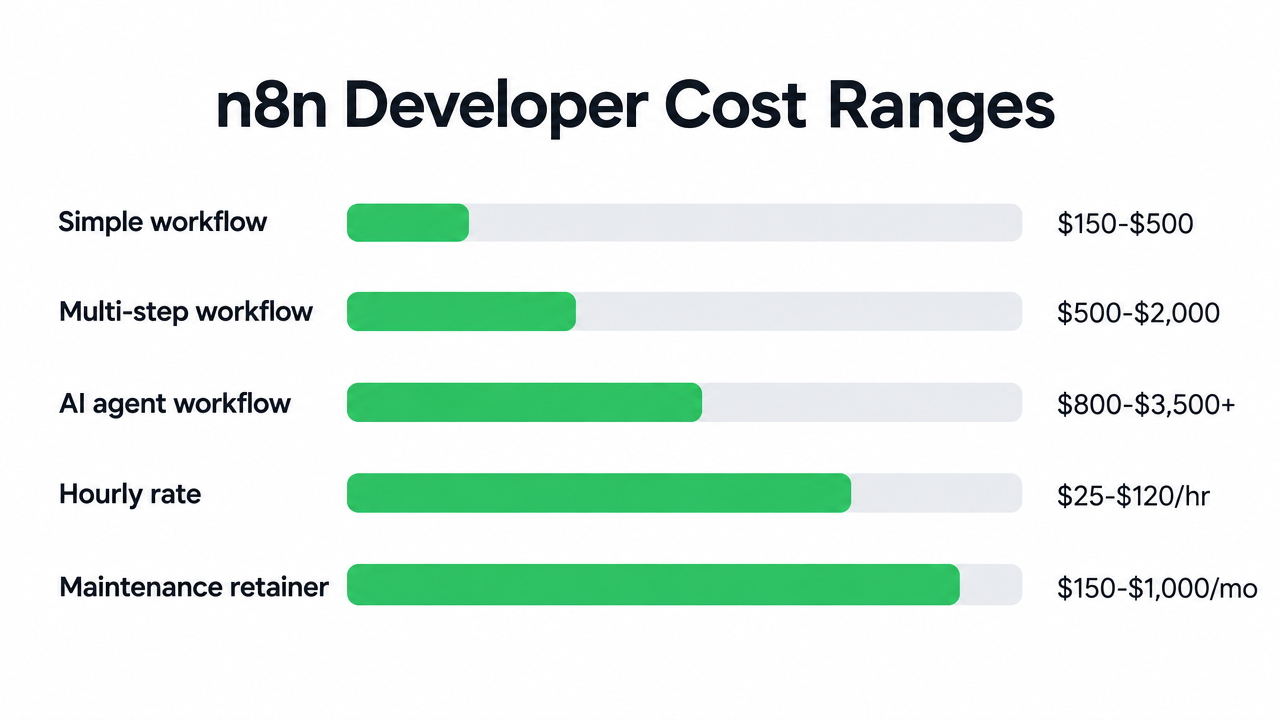
Pricing for n8n development work varies a lot depending on scope, whether you are hiring hourly or project-based, and whether you go through a freelance marketplace or an agency. As a general range based on typical freelance and small-agency rates in 2026:
| Engagement type | Typical range | Best for |
|---|---|---|
| Single simple workflow (1–2 apps, no AI) | $150–$500 flat | Quick integrations, form-to-CRM type tasks |
| Multi-step workflow with branching/error handling | $500–$2,000 flat | Order processing, lead routing, internal ops |
| AI agent workflow (LLM-based) | $800–$3,500+ flat | Support automation, research pipelines, internal copilots |
| Hourly freelance rate | $25–$120/hr | Ongoing or evolving scope |
| Monthly maintenance retainer | $150–$1,000/mo | Keeping existing workflows healthy |
| Agency-led automation program | $3,000–$20,000+ | Multi-workflow rollouts across a whole team |
These numbers move around based on region, complexity, and how much of the groundwork (API access, credentials, documented processes) you have already done before the developer starts. It is also worth separating the developer's fee from your n8n hosting cost — hosting is billed separately and scales with monthly executions, not with the size of your team. Our own platform fees are set out on the pricing page.
Core Skills to Look For When Hiring an n8n Developer
Not every n8n developer needs to be a full-stack engineer, but a few skills separate people who can handle real projects from people who have only followed tutorials.
JavaScript (or at least comfort reading it). n8n's Code node runs JavaScript, and almost every non-trivial workflow eventually needs a bit of custom logic — reshaping an array, handling a null field, formatting a date. If a candidate cannot explain what a Code node does, that is worth noting.
REST API fundamentals. Understanding authentication methods (API keys, OAuth2, bearer tokens), status codes, pagination, and rate limits. Most integration headaches come down to one of these.
Webhook and trigger design. Knowing when to use a webhook versus a polling trigger, and how to make sure a workflow does not process the same event twice.
Error handling patterns. Retry logic, fallback branches, and alerting (Slack or email notifications when something breaks) rather than a workflow that just stops. Our error handling guide shows the patterns a strong candidate should recognise.
Self-hosting and deployment basics , if you are not using n8n Cloud — Docker familiarity, environment variables, and basic server security.
AI/LLM integration , if your project involves agents — prompt design, vector stores, and an understanding of when an AI step is actually the right tool versus deterministic logic.
Where to Find n8n Developers
There are a handful of places people typically look, each with tradeoffs.
General freelance marketplaces like Upwork and Fiverr have a large pool of n8n listings, but quality varies enormously and vetting is entirely on you.
The n8n community forum is where a lot of the most active builders hang out, answering questions and sharing workflow templates — a good place to spot people who clearly know the tool well before you ever talk pricing.
Specialized automation marketplaces , including the automation experts directory on n8n Markets, where freelancers are reviewed specifically on n8n project history rather than generic "automation" experience.
LinkedIn , searching directly for "n8n developer" or "n8n consultant" — useful for finding people with agency or enterprise backgrounds.
Referrals from your existing network — often the fastest route to someone reliable, since you are borrowing someone else's vetting.
How to Vet an n8n Developer Before You Hire
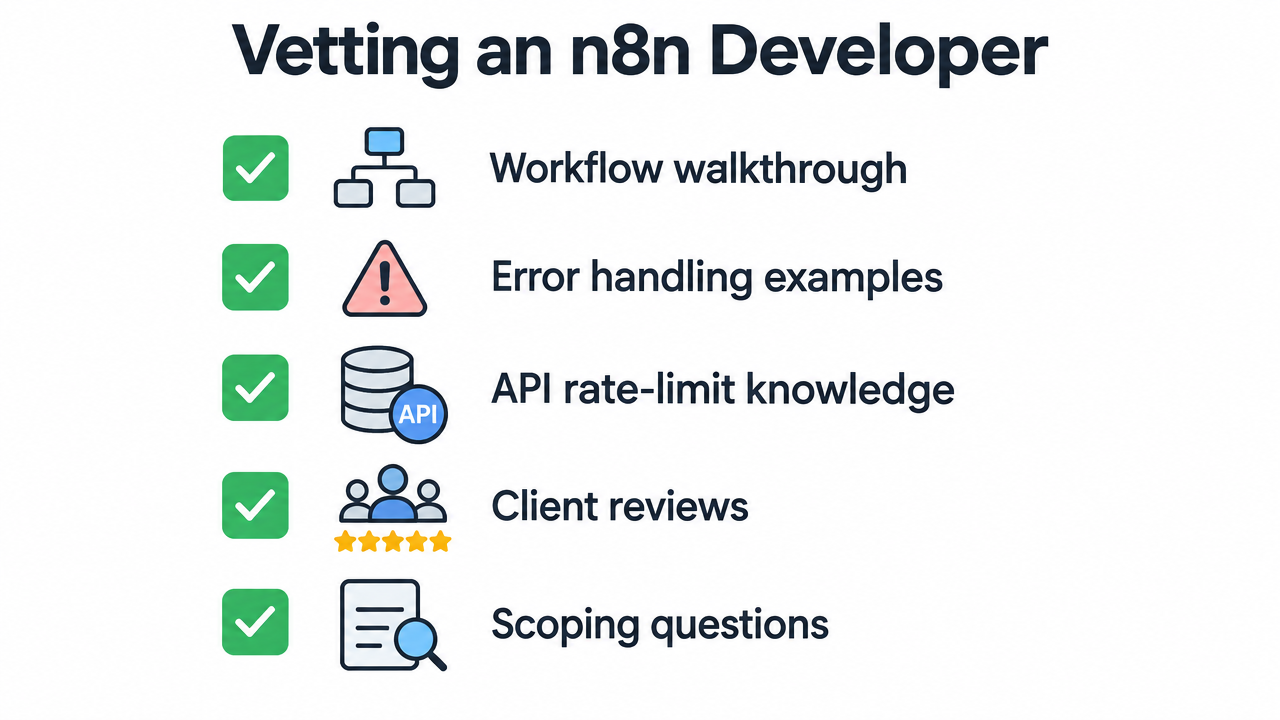
A portfolio full of screenshots is not proof of anything — screenshots do not show you whether the workflow actually handles errors, or whether it is still running six months later. Here is what actually tells you something.
| What to check | Why it matters | Red flag if missing |
|---|---|---|
| Live or video-recorded workflow walkthrough | Shows real logic, not just a static screenshot | Only static images, no explanation of logic |
| Examples of error handling in past work | Separates hobbyists from people who ship production systems | Can't explain what happens when a step fails |
| Comfort discussing API rate limits | Signals real integration experience | Vague or dismissive answers about limits |
| References or reviews from past clients | Confirms delivery and communication, not just skill | No verifiable history at all |
| Clear scoping questions before quoting | Good developers ask before they price | Quotes a price without understanding your systems |
| Familiarity with your specific tools | Reduces onboarding time and mistakes | Has never touched your CRM/platform before |
A quick, low-stakes way to test someone before a big commitment: ask them to review an existing workflow (yours or a sample one) and tell you what could break. Their answer tells you a lot more than a resume does.
Interview Questions Worth Asking
If you are doing a call before hiring, a few questions tend to separate real experience from surface-level knowledge:
- 1
"Walk me through a workflow you built that failed in production. What happened, and how did you fix it?" — Anyone who has shipped real workflows has a story here. If they do not, that is telling.
- 2
"How do you handle a webhook that might fire twice for the same event?" — Tests understanding of idempotency, a common real-world bug.
- 3
"When would you choose a Code node over built-in nodes, and when would you avoid it?" — Tests judgment, not just familiarity with the tool.
- 4
"How do you monitor a workflow after it is live?" — Separates people who build-and-ghost from people who think about ongoing reliability.
- 5
"What is a project you would turn down?" — A confident answer here (rather than "I will build anything") is usually a good sign.
Freelancer vs. Agency vs. In-House: Which Fits Your Project?
| Option | Pros | Cons | Best fit |
|---|---|---|---|
| Freelancer | Lower cost, direct communication, flexible scope | Single point of failure, variable availability | One-off projects, small teams, tight budgets |
| Agency | Redundancy, project management, broader skill coverage | Higher cost, sometimes slower, less direct access to the builder | Larger rollouts, businesses needing SLAs |
| In-house hire | Deep context on your systems, always available | Salary cost, hiring time, narrower single-person skillset | Ongoing, heavy automation needs across many teams |
Plenty of businesses land somewhere in between — hiring a freelancer for the first build, then moving to a maintenance retainer once the workflow is proven and business-critical.
Common Red Flags When Hiring an n8n Developer
A few patterns worth watching for, based on how these projects tend to go sideways:
- Quoting a price before asking a single question about your systems. Real scoping takes a conversation.
- No mention of error handling anywhere in their portfolio or answers. This is the single most common gap between hobby-level and production-level work.
- Reluctance to work in your n8n instance or explain their build. You should own the workflow at the end of the engagement, not be dependent on one person forever.
- Vague answers about data security, especially if the workflow touches customer data or payment information.
- No plan for handoff or documentation. Even a short README describing what each node does saves you weeks of confusion later.
Step-by-Step: How to Hire an n8n Developer
- 1
Write down what you actually want automated, in plain language — the trigger, the steps, and what "done" looks like. You do not need technical detail; that is the developer's job to translate.
- 2
List every tool involved and confirm you have admin access or can get API credentials for each one.
- 3
Decide on hourly vs. flat-rate based on how well-defined the scope is. Well-defined project → flat rate. Evolving or exploratory project → hourly.
- 4
Post the project or browse profiles on a marketplace like n8n Markets, a general freelance platform, or the n8n community.
- 5
Shortlist 2–3 candidates and ask the interview questions above before committing.
- 6
Start with a smaller paid test if the full project is large — a single workflow or a scoped milestone — before committing to the whole build.
- 7
Get documentation and ownership transfer written into the agreement upfront, not negotiated after the fact.
Real-World Examples of What n8n Developers Build
To make this concrete, here is the kind of work that typically shows up in hiring requests:
- Lead routing: a form submission gets enriched with company data, scored, and routed to the right sales rep in the CRM — with a Slack alert if it sits untouched for 24 hours.
- Support automation: incoming tickets get classified by an AI node, routine questions get an automated draft reply for review, and complex ones get flagged and escalated.
- E-commerce order sync: an order in your store triggers inventory updates, a shipping label request, and a customer confirmation email, with retry logic if any step fails.
- Reporting pipelines: data gets pulled nightly from multiple sources, transformed, and dropped into a dashboard or spreadsheet — replacing a manual weekly export someone used to do by hand.
- AI research agents: a workflow that takes a topic, searches the web, summarizes findings, and drops a formatted brief into Notion or Slack.
If you are comparing n8n to alternatives before committing to a hire, it is worth reading how it stacks up against Zapier and Make — the right platform choice affects both cost and who is available to hire. You can also browse concrete builds in our n8n workflow examples library.
Start With a Template, Hire for the Custom Parts
Many projects do not need a from-scratch build. Browse the n8n workflow templates first, and bring a developer in only for the custom last mile — that combination is usually the cheapest path to production. For budgeting the consulting side, our pricing page sets out platform fees, and the n8n use cases library shows what teams automate most.
Frequently Asked Questions
How much does it cost to hire an n8n developer?
Costs typically range from around $150 for a single simple workflow up to several thousand dollars for a multi-step or AI-driven build. Ongoing maintenance retainers usually run $150–$1,000 per month depending on how many workflows you are supporting.
Do I need to already have n8n set up before hiring someone?
No. Most developers can help you decide between n8n Cloud and self-hosting, and can set up the instance as part of the project. If you already have workflows running, they can build on top of your existing setup instead.
Can an n8n developer work with tools that don't have a built-in node?
Yes — this is common. n8n's HTTP Request node lets a developer connect to almost any API that has documentation, even without a dedicated pre-built node.
What's the difference between hiring an n8n freelancer and using a no-code automation service?
A freelancer builds and hands you a workflow you own and can modify later. Many "done-for-you" automation services keep the build on their own infrastructure, which can make switching providers harder down the line.
How do I know if my project is too complex for one freelancer?
If the project spans multiple departments, needs ongoing support across many workflows, or has strict uptime requirements, it is usually a better fit for an agency or a small in-house team rather than a single freelancer.
Will an n8n developer maintain the workflow after it's built?
Some will, some won't — it depends on the agreement. If ongoing reliability matters to your business, ask about a maintenance retainer before the project starts, not after something breaks.
Looking to hire an n8n developer for your next project?
Browse vetted n8n freelancers and agencies, where every profile is reviewed for real project history — not just a claimed skill list.
Browse n8n Developers